

If you run a sales team of 8 to 20 reps at an industrial manufacturer, a specialty distributor, or a private-equity-backed services roll-up, you already know the number. Two percent. That is what the industry says you should expect from cold email. For every hundred personalized, researched, carefully-timed emails your team sends, two people write back. The other ninety-eight delete it before they finish the subject line.
Here is the number that changes the math: forty-four percent.
Not 44% reply rate — let's be precise about what we are measuring. The industry-standard cold email reply rate is 2%. What Blackbook Engine measures is a 44% engagement rate: the percentage of recipients who click the link or watch the video embedded in the email. They do not write back. They do not need to. They take the action that matters first — they engage with something useful you sent them. That engagement fires a notification to the rep's execution board the same day. The rep follows up while the buyer is still warm. That is a fundamentally different outbound motion, and the math behind it is why "just send more emails" stopped being the answer.
The 2% Problem, Quantified
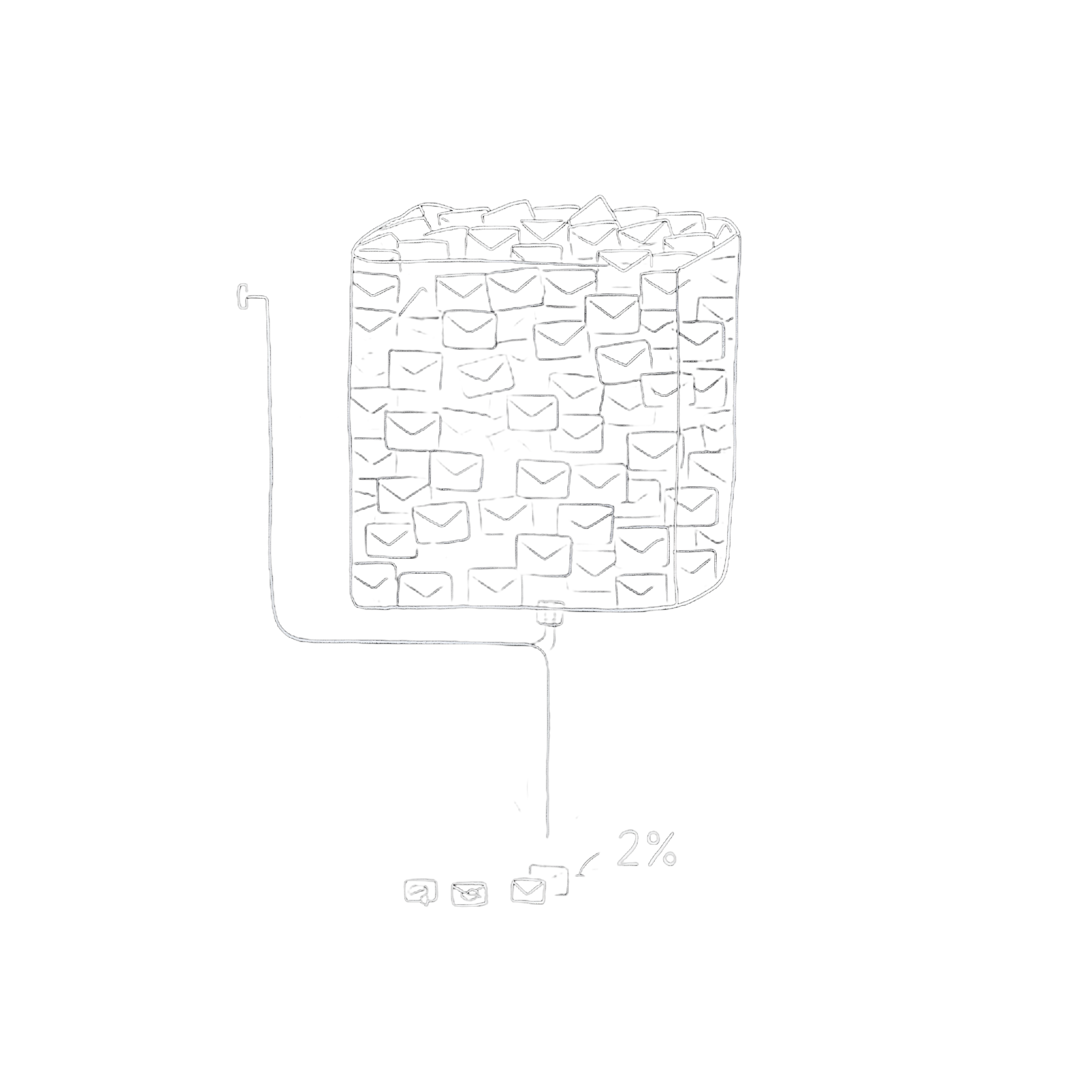
Let us put numbers on the old model. A rep sends 25 personalized outbound emails per day. That is roughly 500 emails per month, accounting for holidays and internal days. At a 2% reply rate, that rep generates 10 replies per month. Some of those are "unsubscribe" or "not interested." Maybe half are worth following up on — 5 qualified conversations from 500 emails.
Now multiply by a team of 10 reps. That is 5,000 emails per month producing 50 qualified conversations. The cost: 10 salaries, 10 seat licenses for a sequencing tool, data enrichment subscriptions, and roughly 120 hours of collective rep time spent researching, drafting, and logging — time those reps are not selling.
Fifty conversations from 5,000 emails and 10 full-time salaries. That is the math that keeps VP of Sales awake at night.
What "44% Engagement" Actually Means

The 44% number is not a reply rate. It is a click-or-watch rate. Here is what happens instead of a reply.
The platform does not just draft an email. A research agent studies the buyer: their role, their industry, their company's known pain points, the buying signal that put them on the board. Then it selects the most appropriate intel asset — a benchmark report, a diagnostic assessment, a compliance playbook, an ROI calculator — for that specific buyer. It mints an individual tracking token for that recipient, injects a trackable link into the email, and the rep approves and sends.
The buyer receives an email that does not read like cold outreach. It reads like someone sent them something genuinely useful. They click. They watch. The rep gets a notification the same day.
The key difference: the buyer does not have to write a reply for the outreach to succeed. The click IS the signal. And 44% of recipients click or watch, compared to the 2% who would have written back to a traditional cold email.
Let us do that math again with the new numbers. Same 500 emails per rep per month. At a 44% engagement rate, that is 220 buyers per rep per month who click or watch. Across a 10-rep team, 2,200 engaged buyers per month — each one a warm follow-up opportunity with a notification already on the rep's execution board.
Two percent versus forty-four percent. Five qualified conversations per rep per month versus 220 engaged buyers per rep per month. That is not incremental improvement. That is a different category.
Why the Mechanism Matters More Than the Number

The stat is memorable because it is surprising. But the mechanism is what makes it repeatable.
Traditional cold email puts the entire burden on the subject line and the first sentence. You are asking a stranger to read your pitch, decide you are credible, and take the time to write a reply — all in the 4 seconds before they hit delete. The conversion math is brutal because the ask is enormous relative to the trust you have built, which is zero.
An intel asset flips the ask. You are not asking the buyer to reply. You are offering them something that has standalone value — a benchmark that tells them how their operation compares to peers, a calculator that models their cost-per-rep, a playbook that solves a problem they already know they have. The email is not "here is why you should talk to us." It is "here is something useful — want to see?" The trust bar for clicking a link is dramatically lower than the trust bar for writing a reply to a stranger.
This is not a copywriting trick. It is a structural change to what goes inside the envelope. The platform does the research, selects the asset, mints the token, and injects the link. The rep reviews every email before it sends — but they are not spending two hours a day researching accounts and guessing what might get a click.
What Happens After the Click
A traditional cold email reply lands in the rep's inbox alongside 80 other unread messages. Maybe they see it the next day. By then the buyer has moved on.
When an intel-asset link is clicked or a video is watched, the rep's execution board lights up the same day. They know who engaged, with which asset, and when. The follow-up is immediate and contextual: "I saw you checked out the industry benchmark — happy to walk you through how your numbers compare." That is a conversation, not a cold pitch.
And every engagement is logged to the CRM automatically. The sales manager's Monday morning pipeline view is not reconstructed from last week's standup. It is live. They can see which buyers clicked which intel assets, which reps followed up same-day, and which accounts are warming up without a reply yet.
The Math at Scale

For a 10-rep team on the old model: 5,000 emails, 50 qualified conversations, 10 salaries, 10 seat licenses, and roughly $12,000/month in rep hours lost to non-selling activity.
For a 10-rep team with intel assets: 5,000 emails, 2,200 engaged buyers, the same 10 salaries, and a platform that covers the research, drafting, asset selection, token minting, and CRM logging automatically. The rep hours previously spent on admin are now spent on follow-up conversations with buyers who have already raised their hand by clicking.
At the self-serve level, the platform runs $150 per seat per month with a 3-seat minimum — $450 per month for a 3-rep pilot team. One qualified deal from an intel-asset engagement covers that cost for the year.
This is what changes the outbound math. Not sending more emails. Sending something worth opening.